The Opening She Left
Six weeks after the night behind the portrait, Leo sat between Daniel and Grandpa Henry at a lawyer-supervised conference arranged through victim services.
Leo had asked to attend after his advocate explained that he could leave at any time.
Rebecca sat across the table beside her attorney with both hands open instead of folding one thumb into her palm.
A crime-scene technician set the sealed evidence bag containing the old brass pin beside a diagram of the portrait frame.
Henry still tired quickly, and a cane rested beside his chair although he had never needed one before the elevator.
The diagram marked six fastening points around the concealed service doors.
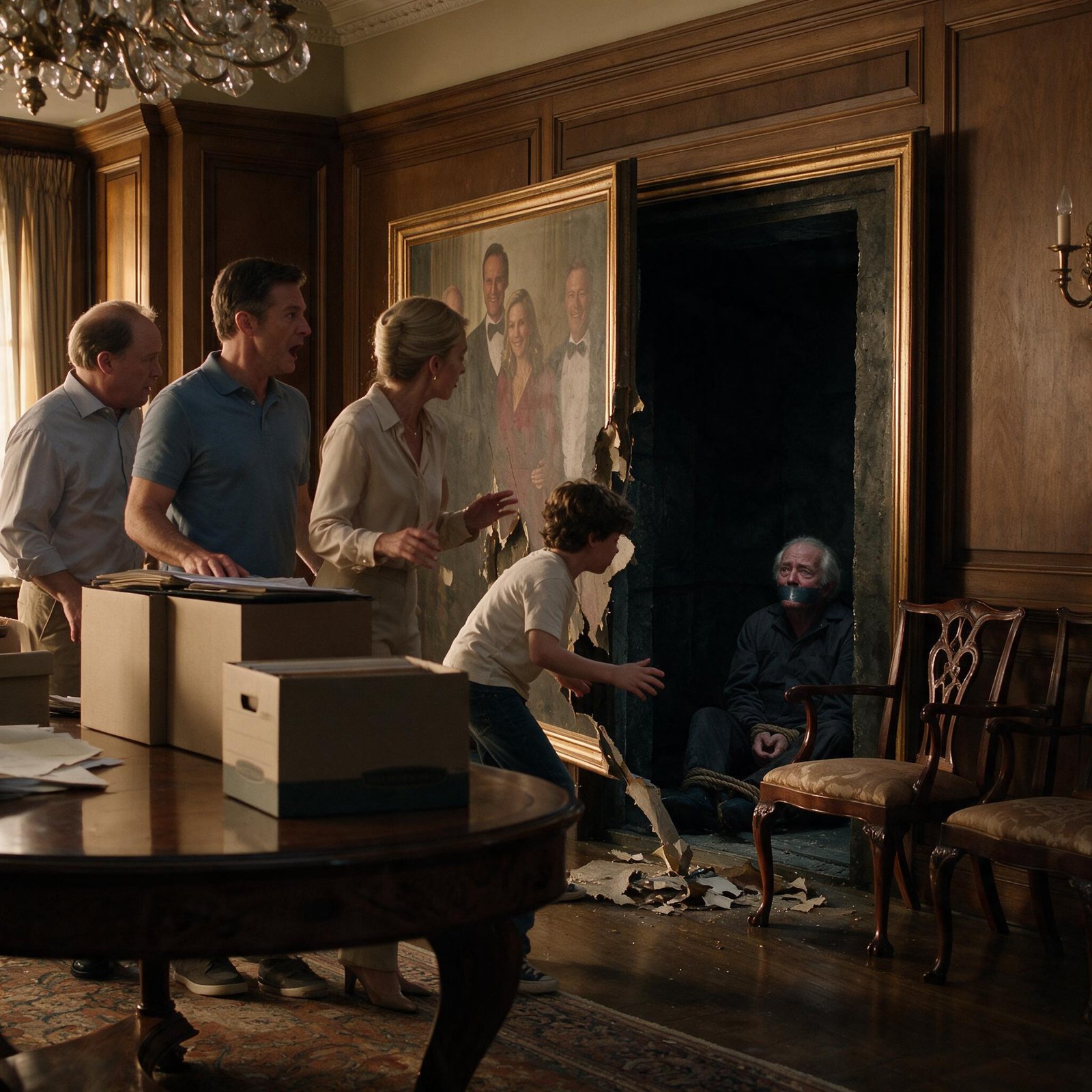
Five anchors had torn through wood when Leo struck the portrait and pulled its broken edge away.
Each of those five holes held splinters bent outward in the direction of his blows.
The sixth hole, at the lower corner where Leo had hit first, was smooth and empty.
Its threaded pin had not snapped, stripped, or been shaken loose by the chair.
Someone had deliberately backed it out before Leo began swinging.
Leo remembered the small brass piece glinting in the rug fringe before he ever grabbed the chair.
At the time, he had taken it for loose hardware from the old house.
The finding alone left two possibilities.
Martin might have forgotten to replace the pin after opening the portrait to hide Henry, or someone might have removed it after the frame was closed to create a weak point.
Henry's account settled the timing.
More than two hours after Martin restrained him and pulled the portrait back into place, Henry heard Martin's heavy steps leave the living room.
Several minutes later, lighter steps returned alone, followed by a slow metal scrape near the floor and the long drag of a wooden chair.
Measurements from the floor placed that fresh scrape beside the same lower corner where the intact pin was found.
The officer who separated Rebecca that night had also documented a fresh crescent abrasion beneath her right thumb.
The abrasion matched someone turning a corroded fastener, though it could not establish intent by itself.
Together, the sequence meant Rebecca had returned to the wall after Martin left, loosened its lower corner, and moved the chair within reach of whoever came looking.
Her formal statement supplied the reason the physical evidence could not.
She said she had hoped Daniel would hear Henry, notice the weakened corner, call the police, and make the decision she had been too frightened to make herself.
When Leo heard the groan and acted first, Rebecca panicked and still said, “Don't open it.”
The reconstruction changed her role, but it did not clean it.
Rebecca had agreed to Martin's sham private-care plan, signed a false affidavit about Henry's capacity, and repeated the medical-emergency lie after she watched Martin restrain her father.
She had delayed calling 911 to protect Martin and herself, then placed the danger of opening the wall in someone else's hands.
The removed pin was one right action buried inside choices she had knowingly made.
Martin remained the person who physically confined Henry and the financial driver of the attempted takeover.
Henry identified the man who had bound him, while the lender records, Cedar Vale invoice, office print log, and draft board notices established how Martin's failing company expected to benefit.
Rebecca looked at Leo without asking him to make her feel better.
“I thought your father would find him,” she said.
Leo looked at the aunt who had made a weak place in the wall and then tried to stop him from using it.
“You left me the opening, but you should have opened it yourself.”
Rebecca closed her eyes for one breath before nodding.
“You're right,” she said.
She did not ask Leo to hug her, forgive her, or call what she had done brave.
Eight months after the rescue, Martin entered a negotiated plea based on the physical confinement and attempted elder financial exploitation after discovery and pretrial motions.
Rebecca accepted a separate negotiated resolution based on the false incapacity affidavit, obstruction, and her participation in the attempted exploitation, while the removed pin counted as mitigation rather than innocence.
At Henry's request, Bellamy Family Holdings appointed Mara Chen as temporary independent fiduciary, required her to report every decision to him, and kept Martin and Rebecca responsible for debts Henry had never pledged to pay.
Daniel declined any temporary control and admitted to Leo that he had entered the mansion thinking about shares while his son had been listening for a person.
Henry finished months of physical therapy and recovered enough to cross the living room with only occasional help from his cane.
He did not promise Rebecca forgiveness, and Daniel did not ask Leo to resume contact with her for the sake of family peace.
The giant family portrait had been wrapped and moved to climate-controlled storage.
In its place stood visible, code-compliant elevator doors, a restored cab, a working emergency release, a monitored alarm, and a current inspection seal.
Leo pressed the alarm button once, heard its clear bell answer through the hall, and stepped back without needing to break anything.
The portrait stayed in storage, and nothing covered the door again.
Part 5 of 5 · The Boy Who Stopped His Family from Taking Grandpa's Fortune