What Noah Came For
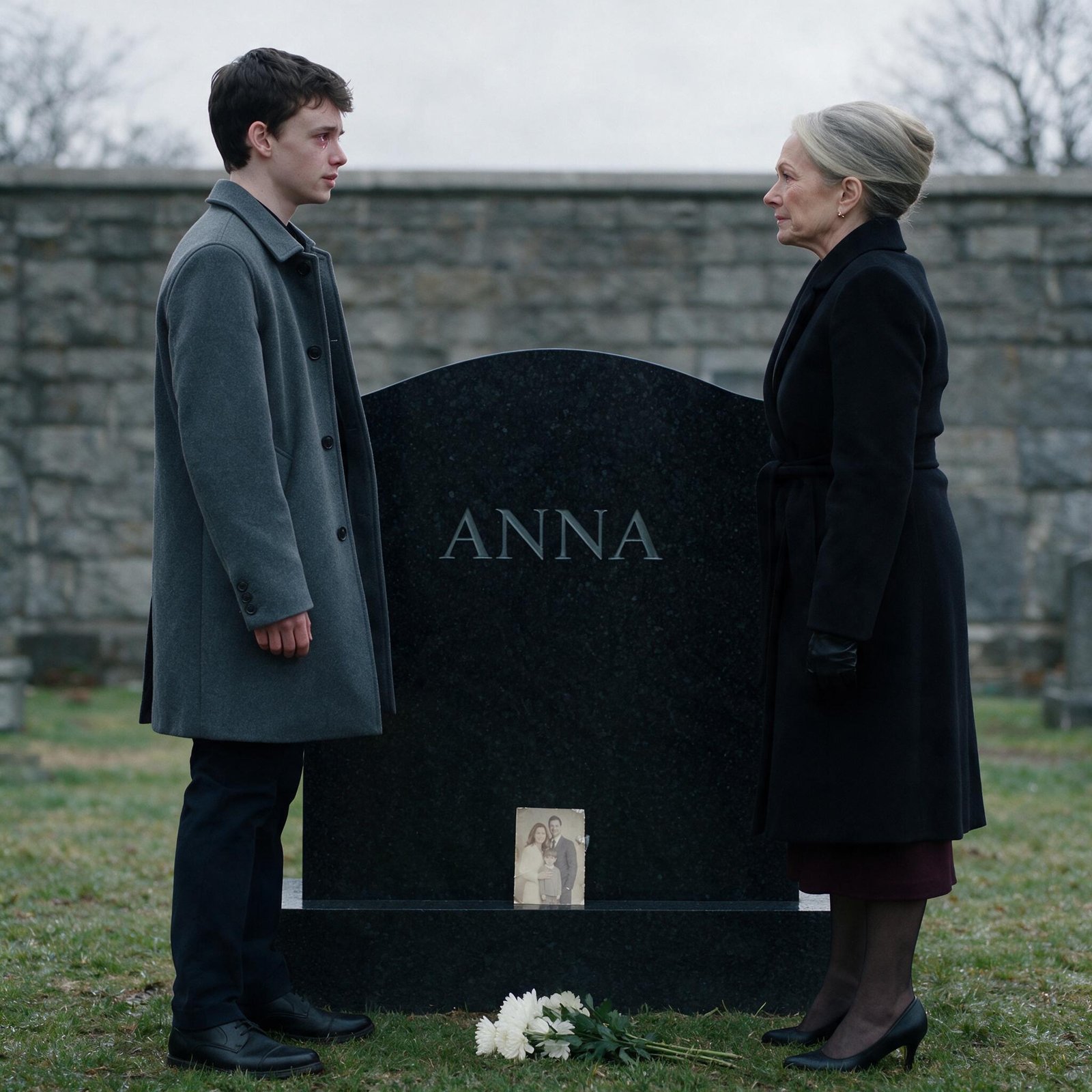
The silence after Eleanor’s rejection held Noah on the left side of the grave while she remained between him and Anna’s headstone.
Disbelief hollowed his face as her words settled between them.
“I never asked you to take me home.”
Eleanor did not turn around immediately.
The white flowers rested at her feet, and the faded photograph remained upright between them with five-year-old Noah caught forever beneath Anna’s hand.
“You came here and called yourself my grandson.”
“I came because you’re her mother, and I want to know who she was before Marcus.”
Eleanor faced him, keeping her body in front of the engraved name.
“And what do you expect me to do with that?”
“Say that she was my mother, say that I was her son, and tell me one thing about her from before she met Marcus.”
The request seemed to unsettle Eleanor more than a demand for money might have, but Noah did not soften it into something easier for her to dismiss.
He wanted no room in her house, no place in a company, and no portion of a fortune that had never fed or sheltered him.
He wanted to know who Anna had been before Marcus and to hear Eleanor acknowledge that Anna had raised a son.
Eleanor looked down at the photograph.
“A picture is not proof.”
“I know.”
Noah explained that he could show his current identification and request a new certified copy of his birth record under his own name.
He also offered to sign a narrow written release allowing the funeral home to confirm only that Anna’s witnessed disposition directive named him as the authorized arranger.
The release would not authorize access to Anna’s medical records, finances, belongings, or any private conversation from her final weeks.
“And you’re making no claim against this family?”
“I am not asking for property, a job, an announcement, or your money.”
For the first time since she had stepped in front of the stone, Eleanor moved aside.
Noah knelt, lifted the photograph from the base, and brushed a grain of dirt from Anna’s faded face with his thumb.
He returned it to the inside pocket of his gray coat and rose without entering Eleanor’s space.
“The funeral home’s number is public, and I’ll leave a release under Anna’s name by the end of today.”
Noah recited his phone number once, then waited while Eleanor repeated it accurately without reaching for a device.
Eleanor watched him as though ordinary verification were another kind of challenge.
“If you are lying, I will know.”
“You already looked at my face and knew enough to punish me for his.”
Noah took one last unobstructed look at Anna’s name before walking back along the left path.
He did not look behind him, and Eleanor did not follow.
They left the cemetery separately.
At his apartment, Noah set the photograph on the kitchen table, opened the county vital-records portal, and began the ordinary application for his own certified birth record.
He entered his full name, date and place of birth, listed Anna Cole as his mother and Marcus Voss as his father, then uploaded his identification and paid the standard fee.
The confirmation estimated several business days rather than offering the instant answer grief always seemed to demand.
That afternoon, he went to the funeral home with his identification and signed a limited release drafted in plain language.
It authorized staff to confirm that Anna’s disposition file named Noah Cole as the arranger and that he had handled her cremation and inurnment.
It authorized nothing else.
Before sunset, the funeral home notified Noah that the requested confirmation had been given to Eleanor.
Her call came nine minutes later.
Noah answered at the kitchen table with the old photograph in front of him.
“They confirmed what you arranged after Anna died.”
“They confirmed the part I allowed them to confirm.”
“That does not explain why my daughter let me mourn a child who was alive.”
Noah traced the crease that crossed the empty space beside Marcus’s shoulder.
“No, it doesn’t.”
“Marcus took her away, and whatever he did afterward kept her afraid of us.”
Noah closed his eyes, because denying Marcus’s harm would have been another way of using Anna.
His father had controlled money, come home drunk, broken dishes and furniture, and made every disagreement feel dangerous long before Anna finally left.
Noah had spent years learning that recovery did not erase damage and that limited contact was not cruelty.
“Marcus hurt her, and I won’t pretend he didn’t.”
Eleanor seized the admission as if it restored the simpler story she wanted.
“Then you understand why I cannot separate you from him.”
Noah refused to let either of them blame Marcus for all sixteen years Anna had remained silent after leaving him.
“Marcus was gone by the time I was six. Mom had sixteen years to come back to you. She chose not to.”